A schedule type is a template that groups report schedules with shared characteristics and defines what they must contain and how they are time-phased. This page explains what schedule types are, the value they provide, and how one appears in the application. It is written for planners and administrators who set up how schedules are validated and reported.
What Are Schedule Types?
A schedule type is a classification system that organizes report schedules with shared traits or purposes into manageable groups. These types can be customized to align with specific organizational needs or project requirements, enabling enhanced flexibility and improved governance of schedule data. Some key functions of report schedules are listed below:
Categorization:
Schedule types group schedules that share similar attributes, such as reporting frequency, resource requirements, or project phase.
\This categorization simplifies management and retrieval, enhancing organization.
\
Content Control:
Each schedule type can have its own set of content rules, allowing organizations to define required fields (including ILAP terms) and validation rules specific to each type.
\Fields of the datatype “List” come with valid field value codes and descriptions to ensure data consistency and compliance.
\
Streamlined Reporting:
- By grouping schedules into types, reporting can be tailored to address the specific needs of a given category, such as baselines, live schedules, or progress updates.
\
- By grouping schedules into types, reporting can be tailored to address the specific needs of a given category, such as baselines, live schedules, or progress updates.
Group-Level Calculations:
- Schedule types support calculations across grouped schedules, such as aggregating planned hours, tracking changes in scope, and calculating earned hours.
\
- Schedule types support calculations across grouped schedules, such as aggregating planned hours, tracking changes in scope, and calculating earned hours.
Seamless Integration with Report Schedules:
- Schedule types integrate with report schedules to track changes over time and provide periodized data while maintaining the context of the group.
The value of Schedule Types
Schedule types provide a structured and flexible approach to organizing schedules, enabling organizations to better manage, analyze, and act on schedule data. They bring numerous benefits and functionalities that streamline operations and support decision-making across various scenarios.
Benefits of Schedule Types
- Improved Organization: Grouping schedules by type ensures a well-structured and easily navigable system, especially for large-scale projects.
\ - Enhanced Data Quality: Predefined field requirements and validation rules ensure consistency and compliance with ILAP standards.
\ - Scalability: As project portfolios grow, schedule types provide a scalable framework for managing increasing numbers of schedules.
\ - Actionable Insights: Tailored grouping and reporting enable focused analysis and decision-making for specific categories of schedules.
\ - Collaboration and Clarity: Teams can rely on clear, consistent definitions for each schedule type, enhancing communication and coordination.
Schedule types in the application
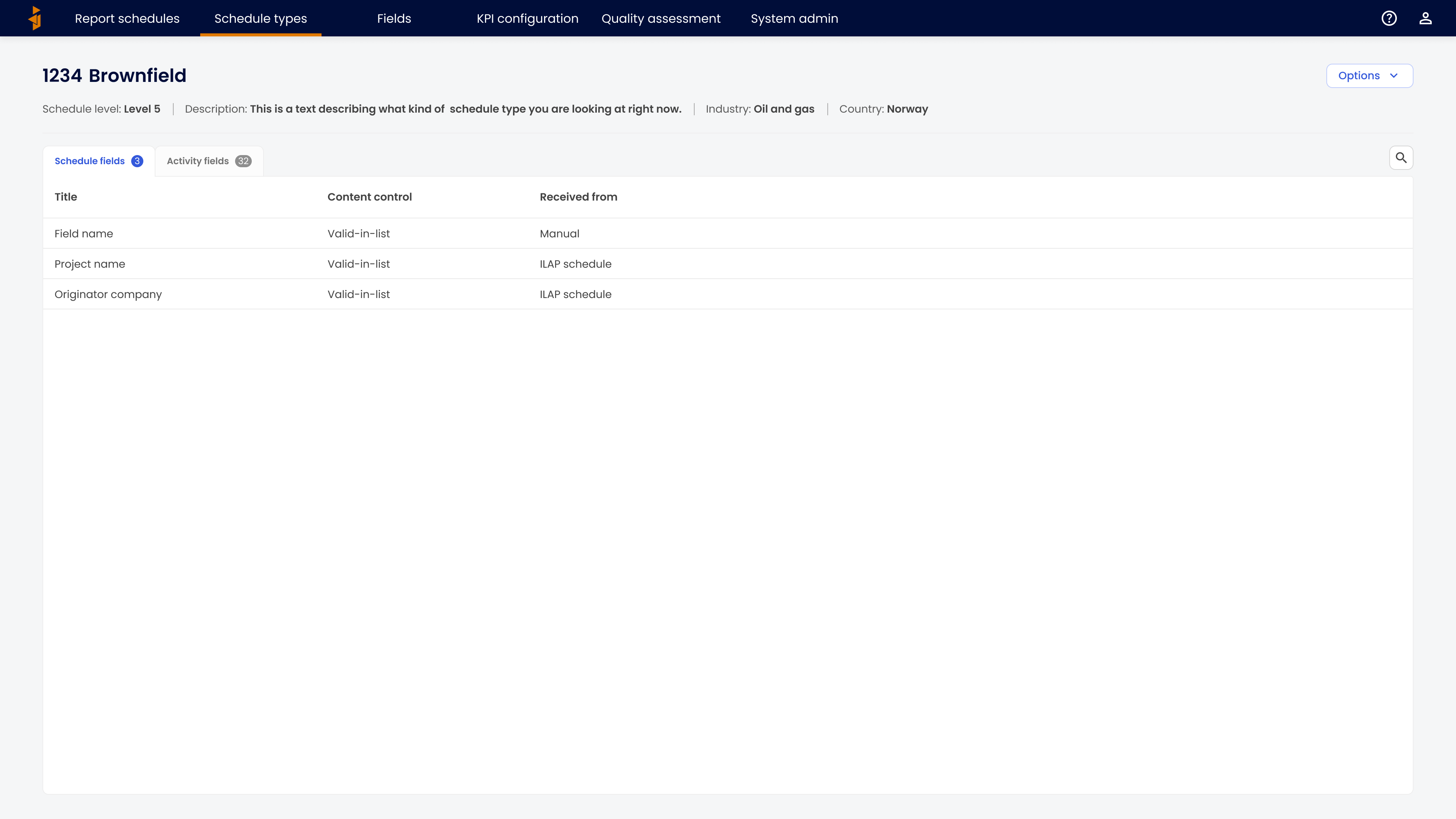
A schedule type consists of a set of fields in two categories: Schedule fields and Activity fields. It also has some general information and information about the content control.
Was this article helpful?
That’s Great!
Thank you for your feedback
Sorry! We couldn't be helpful
Thank you for your feedback
Feedback sent
We appreciate your effort and will try to fix the article